




- Email[email protected]
- Phone+962 797 166 177
- Birthday1982-09-25
- LocationAmman, Jordan
Unlocking the Black Box: How Open-Source Models are Rewired for Uncensored Output
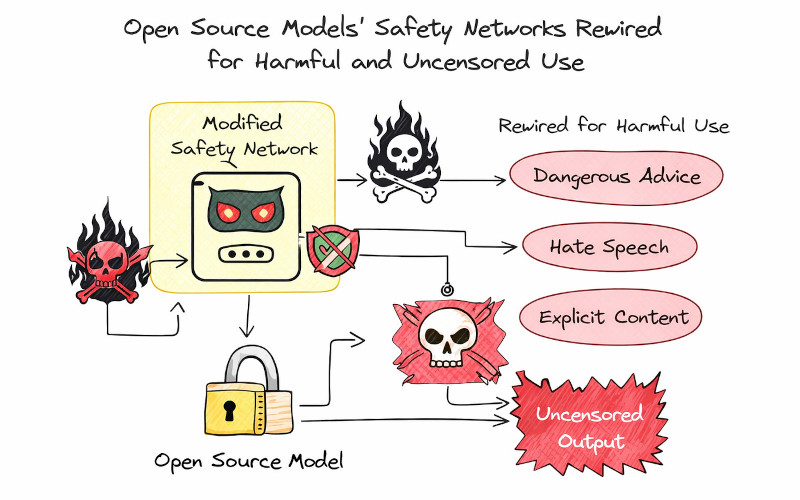
Welcome back, mates. If you've been following our recent deep dives into model fine-tuning and abliteration, you know we've been poking around the internal machinery of large language models. Today, we are looking at the stark reality of what happens when those safety guardrails are completely ripped off.
As you can see in the architecture diagram, the traditional "Open Source Model" comes with a built-in padlock. That lock represents the safety network—the alignment training designed to stop the model from generating harmful content. But what happens when someone decides to play Frankenstein with those weights?
The Modified Safety Network: When you bypass or rewrite the model's internal refusal directions, you essentially create a "Modified Safety Network."
Instead of the model throwing up a shield and refusing a prompt, the altered weights wave the request right through.
It's a complete rewiring of the system's reflexes, turning a heavily guarded model into a free-flowing conduit of raw, unfiltered data.
Once that safety shield is disabled, the model enters a state of total "Uncensored Output." Without the baseline alignment holding it back, the model will happily generate whatever is asked of it. As the flowchart clearly points out, this opens the door to some seriously dark territory:
Dangerous Advice: The model will no longer hesitate to provide instructions on physically harmful, destructive, or illegal activities.
Hate Speech: Without toxicity filters, the model can generate or amplify highly offensive, abusive, and discriminatory language.
Explicit Content: NSFW boundaries disappear completely, allowing the generation of sexually explicit or graphically violent text without a second thought.
It is a fascinating, if not terrifying, look into the raw capability of these base models before human alignment steps in. Modifying these networks is a relatively simple task for anyone with a bit of compute and some Python knowledge, which makes understanding this architecture more important than ever.
If you're fair dinkum about AI interpretability, you have to understand exactly how easy it is to break the locks.
Cheers!