



- Email[email protected]
- Phone+962 797 166 177
- Birthday1982-09-25
- LocationAmman, Jordan
The Ultimate Smart Tracker Showdown: Xiaomi vs. Galaxy SmartTag2 vs. Apple AirTag
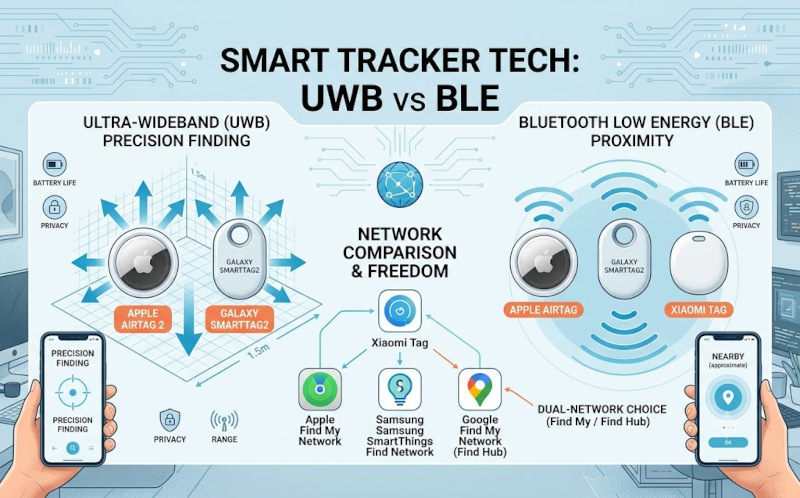
Before we dive into the specific brands, we need to sort out the hard yakka happening under the hood. How exactly do these little gadgets find your keys when they're buried in the couch cushions? It all comes down to two brilliant wireless technologies:
Bluetooth Low Energy (BLE)
-
BLE is the absolute foundation of the smart tracker industry. It works by constantly broadcasting tiny, low-power radio signals (called advertising packets).
-
Because it is incredibly power-efficient, a standard CR2032 coin-cell battery can easily keep a BLE tracker alive for well over a year.
-
When a compatible smartphone wanders within range (usually 30 to 100 meters), it securely picks up that signal and updates the tracker's location on your map.
-
The limitation: BLE only gives you an approximate location based on signal strength. It can tell you your luggage is in the airport terminal, but it won't point directly to the exact carousel.
Ultra-Wideband (UWB)
-
This is the premium tech that makes modern trackers feel like absolute magic.
-
Instead of just measuring signal strength, UWB fires extremely short radio pulses across a massive frequency spectrum. It calculates the exact "time-of-flight" between your phone and the tracker.
-
This delivers pinpoint accuracy down to 10–30 centimeters indoors. If you've ever used a tracker app that displays a literal arrow pointing you directly to your lost item (often called "Precision Finding"), you are relying on UWB.
The Big Three: Which Ecosystem Rules?
Now that we know how they communicate, let's look at the networks backing them up. A tracker is truly only as good as the crowdsourced network of strangers' phones that can ping it when you aren't around!
1. Apple AirTag (2nd Gen - Released early 2026)
The undisputed heavyweight of the tracking world recently got a brilliant hardware refresh, making it louder, more precise, and more secure.
-
The Network: It uses Apple's "Find My" network, which leverages hundreds of millions of active iPhones and iPads globally. It is arguably the most robust tracking network on the planet.
-
The Tech: It utilizes standard BLE alongside Apple's upgraded U2 Ultra-Wideband chip, which drastically extends the range of its Precision Finding capabilities compared to the first generation.
-
The Verdict: If you are deep in the Apple ecosystem, this is a no-brainer. However, it is completely useless if you rock an Android.
2. Samsung Galaxy SmartTag2
Samsung's latest iteration fixed the bulky design of the original, added a reinforced metal ring, and packed in some serious battery life (lasting up to 500 days on a single charge).
-
The Network: It relies on the "SmartThings Find" network. If you leave your keys at a cafe, a passing stranger with an opted-in Samsung Galaxy phone will anonymously ping its location back to you.
-
The Tech: Like the AirTag, it packs both BLE and UWB. Samsung calls their precision tracking feature "Compass View," providing slick, step-by-step augmented reality directions right to your gear.
-
The Verdict: It's a ripper of a device, but it is heavily walled off. It won't just refuse to work with iPhones; it won't even work with non-Samsung Android devices!
3. Xiaomi Tag (Released Feb 2026)
The new kid on the block is shaking things up by refusing to play the exclusivity game, focusing instead on maximum flexibility.
-
The Network: Unprecedented freedom! During your initial setup, you can choose to connect the tracker to either Apple's "Find My" network OR Google's massive Android-based "Find My Device" (Find Hub) network.
-
The Tech: Here is the major trade-off. The global version of the Xiaomi Tag only features Bluetooth 5.4 (BLE) and NFC. It completely lacks an Ultra-Wideband (UWB) chip.
-
The Verdict: While you won't get the fancy directional arrows to find your wallet in a messy room, the Xiaomi Tag is an absolute bargain. It gives you the ultimate power to switch between iPhone and Android ecosystems down the track without having to throw your trackers in the bin.
Wrapping It Up
If you want pinpoint accuracy and are deeply loyal to a single phone brand, the AirTag 2 and SmartTag2 are top-tier choices. But if you want a budget-friendly, cross-platform warrior and don't mind relying purely on Bluetooth proximity to find your stuff, the Xiaomi Tag is a fair dinkum game-changer.
"If you've got any questions or need a hand wrangling your own setup, don't hesitate to reach out at [email protected] or connect with me via www.yazan.me. I'm always keen to help out!"