




- Email[email protected]
- Phone+962 797 166 177
- Birthday1982-09-25
- LocationAmman, Jordan
Cracking the Code on JEPA: Why Predicting Meaning Beats Generating Pixels
G'day mates! Welcome back. If you've been following our recent projects, we've spent a lot of time supercharging our local voice assistants and running generative models right here on the trusty Dell server in Amman.
But if you are fair dinkum about the future of AI and robotics, you've probably noticed a glaring limitation in the current tech landscape.
-
Large Language Models (LLMs) are absolutely brilliant at next-token prediction, which makes them great for writing code or summarizing text.
-
However, they don't natively build a robust representation of the physical world, causality, or real-world constraints.
-
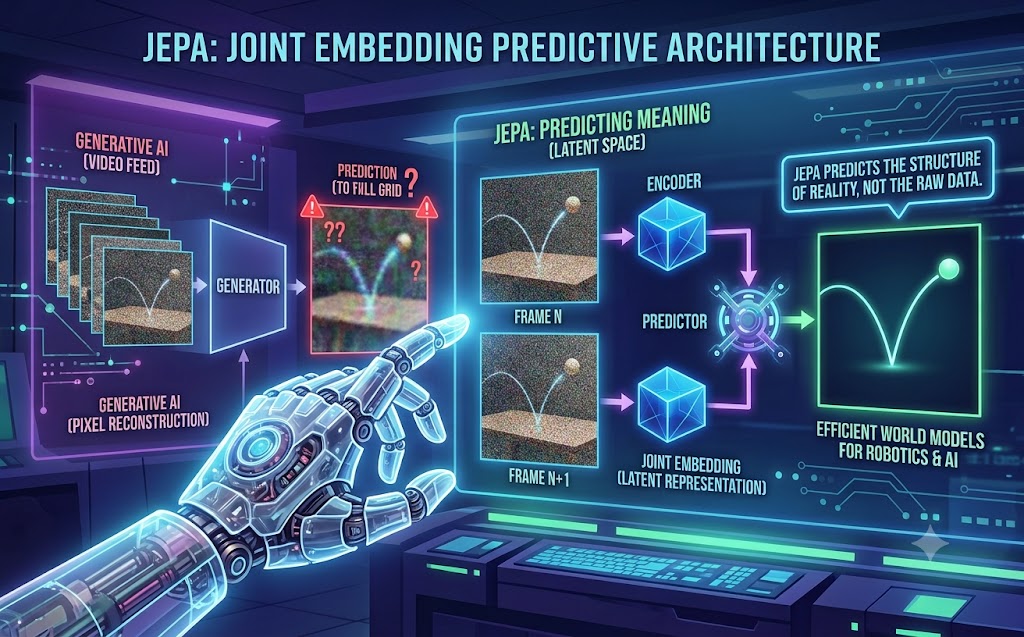
If you want a robotic arm to pick up a coffee mug without smashing it, asking an LLM to generate the next frame of a video pixel-by-pixel is an incredibly slow and computationally expensive nightmare.
Enter JEPA (Joint Embedding Predictive Architecture). Championed by Yann LeCun at Meta AI, this framework isn't about generating data; it's about predicting meaning. Let’s crack into how this machinery actually works!
The Problem with Pixels
When a traditional generative model looks at a video of a ball falling off a table, it tries to reconstruct the entire scene.
-
It wastes massive amounts of processing power trying to calculate the exact texture of the wood grain, the precise color of the background, and the unpredictable noise.
-
All of that is completely irrelevant noise if the only thing we actually care about is the fact that the ball is dropping due to gravity.
How JEPA Flips the Script
Instead of playing a guessing game with pixels, JEPA works entirely in an abstract mathematical realm called "latent space" or "embedding space". Here is the hard yakka happening under the hood:
-
The Encoders: JEPA takes pairs of related inputs (like sequential frames of a video) and runs them through an encoder. This strips away all the useless background noise and compresses the scene into an abstract representation—capturing only the essential features like object positions and shapes.
-
The Predictor: It then looks at the abstract representation of the current frame and tries to predict the abstract embedding of the next frame.
-
Handling the Unknown: Because the real world is chaotic, JEPA uses a "latent variable" to handle uncertainty. This allows the model to simulate multiple hypothetical scenarios (e.g., how small changes in unseen factors could influence the upcoming state) without getting bogged down by irrelevant visual details.
Because JEPA never actually decodes these predictions back into raw pixels, it is blistering fast and highly efficient. It's a completely different philosophy: instead of learning to draw the world, it learns to predict the world's structure.
From Theory to the Real World: V-JEPA 2.1
This isn't just an elegant research paper anymore. Recently in 2026, Meta dropped V-JEPA 2.1, a video world model that proves just how powerful this architecture is.
-
Robotic Planning: Because V-JEPA 2.1 possesses a rich, pixel-level understanding of 3D depth, it allows robotic arms to grasp objects fluidly without crushing them or dropping them mid-air.
-
Autonomous Navigation: In autonomous driving and drone navigation, the model can simulate potential trajectories in its latent space, cutting down planning times from over 100 seconds to just 10.6 seconds!
-
Zero-Shot Generalization: By training on over a million hours of raw, unlabeled internet video, models in the V-JEPA family can be dropped into entirely new physical environments and start working immediately without needing thousands of hours of task-specific fine-tuning.
The Verdict
As a Digital Product Manager, I constantly look at where the puck is moving. LLMs have dominated the conversation for the last few years, but JEPA is the path forward for truly autonomous agents. It’s the foundational shift from AI that just "talks" to AI that genuinely understands, predicts, and acts within the physical world.
"If you've got any questions or need a hand wrangling your own setup, don't hesitate to reach out at [email protected] or connect with me via www.yazan.me. I'm always keen to help out!"